• About Rabbi Daniel M Cohen

Rabbi Daniel M Cohen

Rabbi Daniel M Cohen

Category Archives: TSTI

TSTI Students Learn About Inclusion, Diversity with Artist Julie Wohl- from VillageGreenNJ.com

05 Tuesday May 2015

Posted by danielmcohen in TSTI

≈ Leave a comment


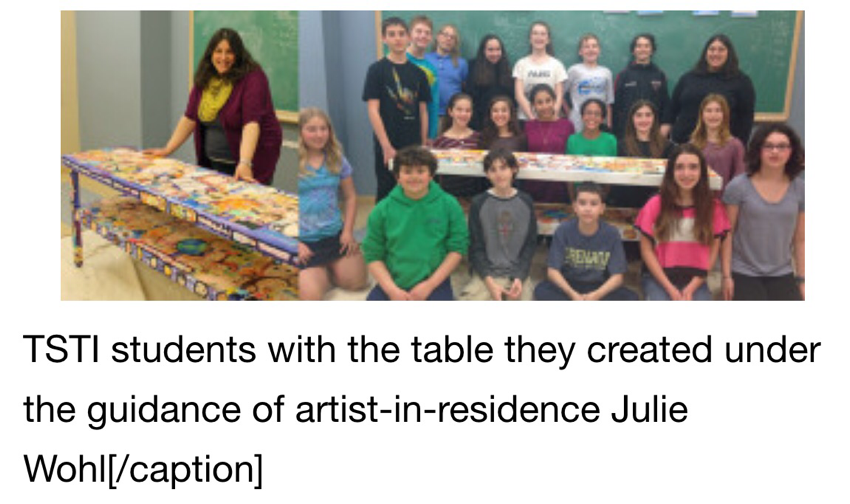
Religious school students at Temple Sharey Tefilo-Israel in South Orange have just completed an art project based on the Jewish concept of b’tzelem elohim – “in the image of God.” The project was spearheaded by Mindy Schreff, director of the Reform synagogue’s Linda and Rudy Slucker Religious School, and artist-in-residence Julie Wohl, who led students age 5 through 13 on a creative journey that combined art with Jewish text.

Schreff worked with Wohl to envision an art piece that would represent b’tzelem elohim, a concept that is closely aligned with the school’s curriculum as well as that of TSTI’s Iris Family Center for Early Childhood Education, which fosters inclusion and diversity. TSTI is known in the wider community for its barrier-free building and commitment to serving students with special needs.

“We wanted to find a way for the students to express the idea of b’tzelem elohim visually,” said Schreff. “We decided to make a table covered in art they created using the theme ‘We all have a place at the table.’” Creating the table was a communal effort: Its construction was completed by Carol Paster, the director of the Early Childhood Center, and volunteers from Habitat for Humanity.

Wohl is a Jewish educator and professional artist who serves as education director at Congregation Brit Shalom in State College, PA, as well as the creator of Jewish Learning Thru Art, a traveling creative arts education program. She led a conversation with students in grades two through seven on Torah texts that deal with b’tzelem elohim, followed by a lesson on painting self-portraits which yielded an array of artworks that were applied to the table. Children in kindergarten and first grade worked with teachers on their own creations to add to the piece.

Wohl also engaged the seventh graders in a discussion that expanded on the idea of how people should act towards each other, given the idea that all are created in God’s image. She added words and phrases from that discussion to the table so that it reflects the insights and artwork from those valuable life lessons. It is currently on display in the synagogue’s lobby.

The temple’s education directors co-developed a similar project in March for Disabilities Awareness Month. TSTI was an exhibitor in February of one of ten “Chairs of Inclusion,” an art installation commissioned by the Jewish Service for the Developmentally Disabled in West Orange for its 10th anniversary. Schreff and Paster brought the lesson of inclusion to their classrooms by working with the seventh graders to build and decorate cube chairs for preschoolers who use the square, high-sided chairs for additional physical and emotional support.

“We are now the proud owners of an amazing heirloom table that represents the welcoming nature of our community, a testament to the power of art that is created with intent and mindfulness,” said Schreff. “Temple Sharey Tefilo-Israel truly makes a place at the table for all of our members and we embrace our diversity. Now we have a visual representation of that for everyone to enjoy for years to come.”

Temple Sharey Tefilo-Israel, located at 432 Scotland Road serves member families from Maplewood, the Oranges, Livingston, Millburn, Short Hills and surrounding areas. The vibrant congregation offers Jewish preschool, Religious school, teen programs, lifelong learning for adults, and a full complement of religious services and cultural programs each month. For more information, visit http://www.tsti.org.

Read the post online 

Ten Minutes of Torah – Celebrating Jewish Arts and Culture

05 Tuesday May 2015

Posted by danielmcohen in TSTI

≈ Leave a comment

  
So proud Debbie Halpern, author of this article, is a member of TSTI. 

I understand why Anthony Doerr’s All the Light We Cannot See won the Pulitzer Prize for fiction last month. It is a beautiful, captivating and moving story. Set in World War II, possibly the most written-about period in history, it manages to cover original ground. The main characters are tragically drawn, rich, and full. Novels as well-written are few and far between and deserving of honors.

It is only upon reflection, and in context, that I find it part of a larger, disturbing trend of well-written, popular novels that cast the Nazi soldier as victim. Like the “must-read” contemporary World War II novel The Book Thief by Markus Zuzak, Doerr’s novel paints a sympathetic portrait of the Nazi soldier – the “everyman” German as the victim of a larger evil force.

What made The Book Thief so interesting was that readers found themselves rooting for the boy in a Nazi uniform. In All the Light, there are a couple of soldier-victims, the most innocent among them a small, frail, artistic German boy who is beaten senseless and left brain damaged by his Hitler Youth peers. There is no mention at all of the Jew as victim of the Nazi regime. In fact, only in one paragraph in the book is a Jew even mentioned – and it is when a character, upon seeing an old Jewish woman, notes that it is the first time he has ever seen a Jew in person.

The evolution of World War II literature has gone from Elie Wiesel’s Night and The Diary of Anne Frank, which focused on the Holocaust and the experience of the Jew, to Schindler’s List, which made heroes of the Germans who risked their lives to help the Jews – and now, we have a story with no Jews in it at all.

That is the part that frightens me. It allows the world to think of the Nazi as victim, without having to imagine the Nazi atrocities. It never explores the side of the conflict that turned these boys into sadistic killers capable of horrors like cutting people open and pouring tar on their insides and shoving people into gas chambers.

It’s only half of the story.

Imagine if someone wrote a book about a slave owner and cast him as a victim of his circumstances – without any mention at all of his treatment of his slaves or their experiences. Doerr may assume that his reader knows that part of history; at minimum, I’m sure he feels it ground that’s been covered by others. But by not mentioning it at all, it is almost as if Doerr is erasing that part of the history.

I have to imagine that the current generation of Germans are doing what they can to understand and make sense of the actions of their ancestors, attempting to comprehend how they could have perpetrated the evils they were guilty of. It’s uncomfortable, I’m sure, to live with the guilt that is passed down along with that – but that’s not an excuse to erase it in the retelling. When throngs of Nazi soldiers sadistically, horrifyingly tortured, murdered, dehumanized, and degraded millions of people, they can’t all be blameless victims. The implication of this is that the only true “bad guys” were at the very top. And while I don’t want to punish the current generation of Germans for the sins of their grandparents, I also don’t want to forget what it was that their grandparents did.

We all know that popular culture shapes opinion, and All the Light We Cannot See has the makings of a great movie, and I worry about this. As overt anti-Semitism is once again on the rise, not only in Europe, but in the U.S., too, it’s important that we don’t accept as the contemporary truth about the Holocaust a story that portrays the people who ushered Jews, Romanys, gays, Catholics, Poles and Slavs to brutal, horrifying deaths, as the victims. It’s important that we don’t allow a reframing of the dialogue that rewrites our history – and that we don’t forget what happens when we look the other way.

Debbie Halpern is is an independent marketing consultant. She is married, the mother of two teenagers and a member of Temple Sharey Tefilo-Israel in South Orange, New Jersey.
A Dangerous Trend in World War II-Era Novels BY DEBBIE HALPERN


Subscribe

  • Entries (RSS)
  • Comments (RSS)

Archives

  • March 2020
  • August 2019
  • May 2018
  • December 2016
  • August 2016
  • May 2016
  • March 2016
  • February 2016
  • November 2015
  • August 2015
  • May 2015
  • December 2014
  • November 2014
  • October 2014
  • September 2014
  • August 2014

Categories

  • Israel
  • TSTI
  • Uncategorized

Meta

  • Create account
  • Log in

Blog at WordPress.com.

Privacy & Cookies: This site uses cookies. By continuing to use this website, you agree to their use.
To find out more, including how to control cookies, see here: Cookie Policy
  • Subscribe Subscribed
    • Rabbi Daniel M Cohen
    • Already have a WordPress.com account? Log in now.
    • Rabbi Daniel M Cohen
    • Subscribe Subscribed
    • Sign up
    • Log in
    • Report this content
    • View site in Reader
    • Manage subscriptions
    • Collapse this bar