In the News- Security Yes, Closed Borders No
26 Thursday Nov 2015
Posted in Uncategorized
26 Thursday Nov 2015
Posted in Uncategorized
17 Monday Aug 2015
Posted in Uncategorized

jewels of Elul is a wonderful way to spiritually prepare for the new year. Craig Taubman and his team share stories and insights all month long. You can sign up to get the daily jewel here… or you can download the iOS app here.
Here’s the first jewel for this new month of Elul…
Elul 1: Rabbi Sharon Brous ~ My First Roommate
facebooktwittergoogle_plusredditpinterestlinkedinmail
I was 18 years old with a dream summer internship, living in dorms packed with socially and politically savvy college students from around the country. My roommate was coming a week late, and I eagerly anticipated her arrival, certain we’d become best friends instantaneously. Way too early one morning, there was a knock on my door. “Hi. I’m your roommate” she said perfunctorily, and walked right past me. “Great to meet you!” I said, “Where are you working this summer?” No answer. “Have you been to DC before?”
I asked, as she made herself busy placing her precious few items on shelves. Still no answer. “There’re some great people on our floor – I’d love to introduce you …” She wouldn’t even make eye contact with me! Feeling pathetic and a bit embarrassed by my outpouring of kindness in the face of her complete disinterest, I turned around and walked out of the room – this was going to be the worst summer of my life. Should I try to switch rooms? Just pack up and head back to New York? I avoided the dorms until about 11:30 that night, and when I finally returned I was relieved to see that my nightmare roommate was asleep. As I crumpled into bed I noticed that there was a note on my pillow. “I’m so sorry we didn’t have time to talk today. My name is Cathy, and I’m working on the Hill. I just want to let you know that I’m deaf, so if I’m not looking directly at you,
I won’t know that you’re talking to me. Please be patient with me – it’s always awkward when I meet new people. By the way, I saw that you’re reading Invisible Man – that’s my favorite book! Can’t wait to get to know you this summer.”
Al chet she’chatanu l’fanekha – for the sin that I committed before You, by assuming the worst of Your children, please forgive me.
Rabbi Sharon Brous is the founder and spiritual leader of IKAR, a vibrant new Jewish spiritual community in Los Angeles. http://www.ikar-la.org
05 Tuesday May 2015
Posted in TSTI
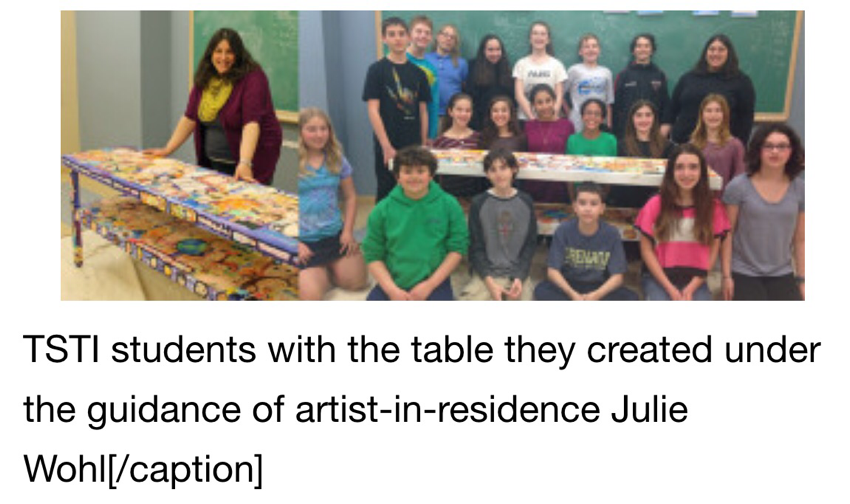
Religious school students at Temple Sharey Tefilo-Israel in South Orange have just completed an art project based on the Jewish concept of b’tzelem elohim – “in the image of God.” The project was spearheaded by Mindy Schreff, director of the Reform synagogue’s Linda and Rudy Slucker Religious School, and artist-in-residence Julie Wohl, who led students age 5 through 13 on a creative journey that combined art with Jewish text.
Schreff worked with Wohl to envision an art piece that would represent b’tzelem elohim, a concept that is closely aligned with the school’s curriculum as well as that of TSTI’s Iris Family Center for Early Childhood Education, which fosters inclusion and diversity. TSTI is known in the wider community for its barrier-free building and commitment to serving students with special needs.
“We wanted to find a way for the students to express the idea of b’tzelem elohim visually,” said Schreff. “We decided to make a table covered in art they created using the theme ‘We all have a place at the table.’” Creating the table was a communal effort: Its construction was completed by Carol Paster, the director of the Early Childhood Center, and volunteers from Habitat for Humanity.
Wohl is a Jewish educator and professional artist who serves as education director at Congregation Brit Shalom in State College, PA, as well as the creator of Jewish Learning Thru Art, a traveling creative arts education program. She led a conversation with students in grades two through seven on Torah texts that deal with b’tzelem elohim, followed by a lesson on painting self-portraits which yielded an array of artworks that were applied to the table. Children in kindergarten and first grade worked with teachers on their own creations to add to the piece.
Wohl also engaged the seventh graders in a discussion that expanded on the idea of how people should act towards each other, given the idea that all are created in God’s image. She added words and phrases from that discussion to the table so that it reflects the insights and artwork from those valuable life lessons. It is currently on display in the synagogue’s lobby.
The temple’s education directors co-developed a similar project in March for Disabilities Awareness Month. TSTI was an exhibitor in February of one of ten “Chairs of Inclusion,” an art installation commissioned by the Jewish Service for the Developmentally Disabled in West Orange for its 10th anniversary. Schreff and Paster brought the lesson of inclusion to their classrooms by working with the seventh graders to build and decorate cube chairs for preschoolers who use the square, high-sided chairs for additional physical and emotional support.
“We are now the proud owners of an amazing heirloom table that represents the welcoming nature of our community, a testament to the power of art that is created with intent and mindfulness,” said Schreff. “Temple Sharey Tefilo-Israel truly makes a place at the table for all of our members and we embrace our diversity. Now we have a visual representation of that for everyone to enjoy for years to come.”
Temple Sharey Tefilo-Israel, located at 432 Scotland Road serves member families from Maplewood, the Oranges, Livingston, Millburn, Short Hills and surrounding areas. The vibrant congregation offers Jewish preschool, Religious school, teen programs, lifelong learning for adults, and a full complement of religious services and cultural programs each month. For more information, visit http://www.tsti.org.
05 Tuesday May 2015
Posted in TSTI

So proud Debbie Halpern, author of this article, is a member of TSTI.
I understand why Anthony Doerr’s All the Light We Cannot See won the Pulitzer Prize for fiction last month. It is a beautiful, captivating and moving story. Set in World War II, possibly the most written-about period in history, it manages to cover original ground. The main characters are tragically drawn, rich, and full. Novels as well-written are few and far between and deserving of honors.
It is only upon reflection, and in context, that I find it part of a larger, disturbing trend of well-written, popular novels that cast the Nazi soldier as victim. Like the “must-read” contemporary World War II novel The Book Thief by Markus Zuzak, Doerr’s novel paints a sympathetic portrait of the Nazi soldier – the “everyman” German as the victim of a larger evil force.
What made The Book Thief so interesting was that readers found themselves rooting for the boy in a Nazi uniform. In All the Light, there are a couple of soldier-victims, the most innocent among them a small, frail, artistic German boy who is beaten senseless and left brain damaged by his Hitler Youth peers. There is no mention at all of the Jew as victim of the Nazi regime. In fact, only in one paragraph in the book is a Jew even mentioned – and it is when a character, upon seeing an old Jewish woman, notes that it is the first time he has ever seen a Jew in person.
The evolution of World War II literature has gone from Elie Wiesel’s Night and The Diary of Anne Frank, which focused on the Holocaust and the experience of the Jew, to Schindler’s List, which made heroes of the Germans who risked their lives to help the Jews – and now, we have a story with no Jews in it at all.
That is the part that frightens me. It allows the world to think of the Nazi as victim, without having to imagine the Nazi atrocities. It never explores the side of the conflict that turned these boys into sadistic killers capable of horrors like cutting people open and pouring tar on their insides and shoving people into gas chambers.
It’s only half of the story.
Imagine if someone wrote a book about a slave owner and cast him as a victim of his circumstances – without any mention at all of his treatment of his slaves or their experiences. Doerr may assume that his reader knows that part of history; at minimum, I’m sure he feels it ground that’s been covered by others. But by not mentioning it at all, it is almost as if Doerr is erasing that part of the history.
I have to imagine that the current generation of Germans are doing what they can to understand and make sense of the actions of their ancestors, attempting to comprehend how they could have perpetrated the evils they were guilty of. It’s uncomfortable, I’m sure, to live with the guilt that is passed down along with that – but that’s not an excuse to erase it in the retelling. When throngs of Nazi soldiers sadistically, horrifyingly tortured, murdered, dehumanized, and degraded millions of people, they can’t all be blameless victims. The implication of this is that the only true “bad guys” were at the very top. And while I don’t want to punish the current generation of Germans for the sins of their grandparents, I also don’t want to forget what it was that their grandparents did.
We all know that popular culture shapes opinion, and All the Light We Cannot See has the makings of a great movie, and I worry about this. As overt anti-Semitism is once again on the rise, not only in Europe, but in the U.S., too, it’s important that we don’t accept as the contemporary truth about the Holocaust a story that portrays the people who ushered Jews, Romanys, gays, Catholics, Poles and Slavs to brutal, horrifying deaths, as the victims. It’s important that we don’t allow a reframing of the dialogue that rewrites our history – and that we don’t forget what happens when we look the other way.
Debbie Halpern is is an independent marketing consultant. She is married, the mother of two teenagers and a member of Temple Sharey Tefilo-Israel in South Orange, New Jersey.
A Dangerous Trend in World War II-Era Novels BY DEBBIE HALPERN

03 Wednesday Dec 2014
Posted in Uncategorized

Dear Friends,
Almost a year ago, we set out to build a new TSTI website from the ground up. I’m excited to announce that our brand new website TSTI.org is online!
The new website has a clean look, will always be up-to-date and is a powerful way to deepen your connection to Temple. Here are a few of the state-of-the-art features:
A comprehensive Calendar that will make it easy and efficient to find out what is happening. It is also directly linked to event registrations.
Online Registration for Events and, if there is a registration fee, Online Payment.
Direct Bill Payment and Donation opportunities.
Two Integrated Blogs. One (TSTI Blog) will have a variety of posts and links from the various clergy and TSTI departments. The other (Rabbi’s Blog) will allow me to share important articles I recommend, my writings, and more.
Our Facebook page and Twitter feed right on our new home page.
“Streamed Services” to watch at home is as simple as clicking the button on the homepage.
A Password Protected Membership Directory.
In addition you will, of course, find… Tons of Photos, new ways to get involved in Social Action, Adult Education, and various committees. Take a look at Worship information, Holiday Resources, Bar/Bat Mitzvah information, Pre-School and Religious School information (including all forms, registration links, etc.), Musical resources so you can learn the music we sing at services, resources on Lifecycle Events, ways to connect to the larger Jewish World, and, of course, our TSTI History. We also have information for Prospective Members so please share with your friends!
The Photo and Video Albums as well as the music page are still being populated so they will be further developed in the months to come. (We would love it if a few volunteers came forward to help us make this happen in an even quicker manner. Let us know if you are available.)
This website is the result of a tremendous number of people’s hard work. And while I thank all of them, there are two individuals in particular who deserve our communal gratitude.
Lana Rosenberg is a graphic designer par excellence. Lana lent her unique talents and skills to helping make the new website as gorgeous as it is. It is fair to say that there is not a single pixel of the new website that has not had to pass muster with Lana. For her artistry, attention to detail and total dedication to this project, I, and we, thank her.
Sue Wishnow, our temple’s Vice President of Community, is the reason for the new website. Sue has not only been the driving force behind the development of the new website but she has spent hundreds of hours (and while rabbis are prone to exaggeration there is no exaggeration here…) making sure this not only happened but making sure it happened in the most comprehensive way possible. Sue took the lead on this project, rolled up her sleeves and got it done.
Thank you also to TSTI member Dimitri Vorona of Hoster.com and Ron Conti of Tech Marvel. Dimitri and Ron have been donating the hosting of the temple’s previous website for years. That has been an incredible gift to this community and I want to publicly thank them for doing so.
Like Temple itself, this new website is a work in progress. We welcome your comments – particularly if you find any glitches/typos. We have done our best to make it as efficient, clean and as logical as possible.
To bring this long email to a close – TSTI is a community. We connect with one another and our tradition on multiple levels. The new website is designed to enhance one of the ways we connect. We hope it is, to steal the phone company’s old saying, “the next best thing to being there”. Our real hope, however, is that it will encourage you to get more involved, attend more services and events, read, learn, and share more of the information we will post.
Go online and check it out here!! TSTI.org
With peace,
Rabbi Daniel M Cohen
03 Wednesday Dec 2014
Posted in Israel
Charlie Rose interviews columnist Richard Cohen in this video clip. Cohen wrote an Op Ed in the Washington Post a few years ago that drew a great deal of criticism. That column prompted him to begin doing more reading no research. That resulted in a new book
The video is worth reading….
18 Tuesday Nov 2014
Posted in Israel
The news to which many of us awoke was nothing short of horrifying. Jews who came to the synagogue to worship in Jerusalem were murdered in cold blood as they prayed. All four men were killed simply because they were Jews.
Ours is a tradition that teaches the value of each and every life. Because of that, each death- particularly of an innocent person- is tragic. When the innocent murdered are members of our extended Jewish family, it becomes personal.
Our tradition teaches, “all members of the community of Israel are responsible for one another.” No matter how we may differ in our political views or religious observance, we are connected. And when one of us suffers, we all suffer. Today we all suffer. Today we all grieve.
Let us be clear. This was cold-blooded murder. It was not a crime perpetrated by crazed killers, but was an intentional act of evil. It is a simple as that.
Let us also be clear that this terrorist attack was not about the territories, nor was it about the Temple Mount. Rather, this attack reflects peoples’ inability to let Jews live, and worship, in peace.
I am troubled by the overall international silence about this morning’s horror. And I cannot help but wonder: where is the worldwide outcry and condemnation of this act?
My friend and colleague Rabbi Menachem Creditor wrote earlier today in the Times of Israel:
…I cringe as I type these next words but dare not ignore reality: Where is the outrage of the Palestinian leadership at Jewish (and Druze and Muslim and Christian) Israeli deaths? Where are the Palestinian statements condemning violence? The immortal words of Prime Minister Golda Meir ring in my ears:
Peace will come when the Arabs will love their children more than they hate ours.
I want Palestinian children to live. I want my children to live. This awful cycle of violence will only change when Palestinian leadership teaches Palestinians that every child deserves life, that “martyr” is just another word for “dead,” and that Jewish blood matters as much as Arab blood.
Read the post.
Anti-Semitism – in Europe, in the U.S., in Australia, on our college campuses, and in Israel – is real.
The time has come for us to care as much about the suffering of our own people as we do the suffering of others. We must demand that the world offer up the same level of outcry when Jews are murdered as they do when criticizing Israeli policies with which they do not agree.
In the current environment, it is more important than ever that we support Israel and to do everything possible to help make sure the U.S.-Israel relationship is strong.
It is also more important than ever that we not give up:
On the struggle for peace between Jews and Arabs;
On maintaining our own moral standards;
On taking pride in the miracle of Zionism and Israel
We are taught
“Those who sow with tears shall reap with joy.” (Ps. 126:5)
Today we sow in tears over the tragedy in Jerusalem. As we do, let us also turn those tears into renewed commitment.
With Peace-
Rabbi Daniel M Cohen
08 Wednesday Oct 2014
Posted in Uncategorized
05 Sunday Oct 2014
Posted in Uncategorized
Yom Kippur AM 214 – 5775
This past July it was reported that ISIS had destroyed the Tomb of Jonah in Iraq. My surprise was not around the fact that ISIS would destroy a holy place… after all, one cannot expect a group that beheads people to respect sacred space. No, I was surprised because I didn’t even know there WAS a Tomb of Jonah. And I was only learning about it after it was gone.
Thanks to an online search and some study, I received a bit of an education. I learned that within present-day Mosul is the ancient Assyrian capital of Nineveh, where the Prophet Jonah preached.
This prompted me to go back and reread the Book of Jonah.
For those of you who do not recall the story:
God tells the prophet Jonah to go to the city of Ninevah and warn the people there that they need to change their evil ways or face God’s divine wrath. Jonah does not want the job, so he runs away and boards a ship. God sends a storm and the seas do not calm until Jonah is thrown overboard. God then sends a huge fish that swallows Jonah. After spending a few days inside the fish, Jonah escapes, makes his way to Ninevah and warns the residents as God had initially requested. The people repent. God accepts their repentance. Jonah is angered by God’s forgiveness. He runs yet again, and settles beneath the shade of a gourd. God causes the tree to shrivel and die. Jonah is bereft and God asks him why he would mourn a tree to which he had no personal connection but be angered when God accepts the repentance of thousands.
Jonah’s tale is widely understood to be one of repentance and forgiveness. These dual themes, I had always assumed, were the reason why the book is read, or in our case will be retold, during the Yom Kippur afternoon service. But as I reread the story, I could not help but see Jonah in a negative light. He does not want to be involved in the affairs of Ninevah. He does not want the responsibility that comes with being a prophet of God, and he tries to abdicate his responsibility by running away.
And I came to the conclusion that a central lesson of the Book of Jonah is… Don’t Be Jonah.
Jonah runs away. His story reminds us that we cannot.
Jonah disengages. His story reminds us that we should not.
Jonah abdicates responsibility. His story reminds us that we must not.
I was in Washington two weeks ago for a gathering of the AIPAC National Council. While there, I was interviewed for a brief film that will be shown during an upcoming AIPAC event.
The first question I was asked was, “What does patriotism mean to you?”
My answer: “Patriotism means making your voice heard as part of the political and social process.”
The next question was, “When do you feel most patriotic?”
My answer: “I feel most patriotic when I walk into a voting booth each November and when I visit Capitol Hill and lobby on behalf of an issue.”
The third question was, “When do you feel most proud to be an American Jew?”
My answer: “I feel most proud to be an American Jew each time I look at the painting on the wall of my study at Temple. It depicts the ship on which my grandfather came from Europe. That ship gave my family the opportunities I now enjoy. And each time I look at the painting, I am reminded of how fortunate I am to be an American, and how, with that good fortune, comes great responsibility.”
The picture reminds me that we American Jews are in a position to further the values we hold dear through our active involvement. In recent months I have witnessed first-hand the impact of such citizen involvement in the political process. It is no accident that the one piece of legislation passed by Congress during the summer was in support of emergency aid for further development of Iron Dome. And it is why the Senate unanimously passed the Strategic Partnership Act between the US and Israel two weeks ago.
Those favorable outcomes only happened because of citizen involvement in the political process. In this case, the support was, in part, the result of lobbying and educational efforts with regard to the importance of the US-Israel relationship. It is why I and others in our congregation, not to mention thousands of American Zionists, have spent countless hours in congressional offices meeting with our leaders and their staffers.
As my colleague Rabbi Elliot Cosgrove said to his congregation on Rosh Hashanah-
To live in this day and age, with the unprecedented freedoms that American Jews enjoy, and not be engaged [ ] – on campus, on Capitol Hill, in youth education, or wherever your passions, politics, and pocket move you – is an abdication of Jewish identity no less egregious than any other sin of commission or omission we will list the days to come.
I recently had the opportunity to hear a panel discussion with Mosab Hassan Yousef. Mosab is the son of a Hamas founder and leader Sheikh Hassan Yousef. From 1997 to 2007, Mosab worked undercover for Israel’s internal security service. The information he supplied prevented dozens of suicide attacks and assassinations of Israelis, exposed numerous Hamas cells and assisted Israel in hunting down many militants, including his own father.
During our discussion, one of the people I was with asked, “Do you recognize the State of Israel?”
Mosab replied, “Do I recognize the State of Israel? I served Israel. I put my life at risk for Israel. Do I recognize Israel? I love Israel.” He then went on, “ To the person who asked the question, I ask: Where are your deeds? Where are your actions?”
Where. Are. Your. Actions? It is one of the key questions I believe we should be asking ourselves in this new year.
Many causes are worthy and in need of our action this year. Two such examples are gun control and immigration.
The Mishnah says-
Whoever destroys a life, it is considered as if he destroyed an entire world. And whoever saves a life, it is considered as if he saved an entire world. — Mishnah Sanhedrin 4:9
Ours is a tradition that values each and every life. That simple but important commitment means we American Jews have a moral obligation to raise our voices and demand a change in gun safety laws. Time and again our leaders have shown that they are not willing to take the steps necessary to make our nation safer. Gun safety advocates like me are not looking to eliminate all guns, but we do want to see the implementation of serious steps that help prevent future gun tragedies. Those changes will only happen if we speak up and make it clear that we expect – that we demand – that thoughtful measures be taken… and implemented.
The good news is that getting involved is as simple as showing up at the Millburn-Short Hills Gun Safety Forum on October 14th at 7pm. Our own Debbi Shedlin and Debbie Taffit are among the organizers of this important gathering.
Another example:
Leviticus 19:34 states
The foreigner residing among you must be treated as your native-born. Love them as yourself, for you were foreigners in Egypt. I am the LORD your God.
Because we are a community of immigrants, it is incumbent upon us to ensure that our immigration laws are both effective in protecting our nation and moral and fair in their enforcement. Through my involvement with Rabbis Organizing Rabbis, a joint effort of the social justice arms of the Reform Movement, I learned that not only does our current immigration policy not protect our nation, but that it is also the antithesis of moral. And while I will be addressing this issue in more depth in the coming weeks, I do want to share one story with you that illustrates this point… and the impact our efforts can make.
It is the story of case #072417781. Or as his family likes to call him – Guerrero A. Catalino. Catalino is not a number. He is a father and a grandfather. He has lived and worked in Union City, NJ since 1991. He has no criminal convictions, and his deteriorating health requires medical attention from his family, all of whom live in the United States.
Mr. Catalino was scheduled for “voluntarily deportation” by Thursday, August 28th.
There was no justification for this deportation, and our small group began making calls and sending letters on his behalf. Two days before Mr Catalino was scheduled to be deported he received a Stay of Removal. The calls and the letters had impact.
There is much work to do and, as the Talmud says-
Lo Alecha HaM’lacha Ligmor – we are not required to finish the task
VeLo Atah Ben Chorin LeHibatel Mimena– but that does not mean we do not have a role to play. (Pirke Avot 2:16)
We do… And we must.
In Jonah I see someone who has no sense of priorities, no ability to forgive, and no appreciation for his responsibility to others. Jonah is all about Jonah. It is why he runs away from God’s decree. It is why he cannot celebrate when the people of Nineveh ultimately repent. It is why he cares more about a gourd that gives him comfort than he does about the well-being of thousands.
Jonah does not change, grow or evolve over time, and that is what I expect from our biblical role models. It certainly is what we see with Abraham, with Isaac, and with Jacob, as well as with Moses and Isaiah. Jonah, on the other hand, is about as static a figure as we will find, despite the fact that he has some of the most engaging experiences of any biblical character.
I was discussing my realization about Jonah with my friend and colleague Rabbi Greg Litcofsky, and he asked me what I thought it was about Jonah that made him unwilling or unable to evolve as a human being. Ultimately we agreed that he is a character who simply doesn’t care. He doesn’t care about the Ninevites. He doesn’t care about accomplishing the task that God put before him. He doesn’t care about the sailors on the ship. And, even after he has achieved God’s role for him and saved the city of Nineveh, as soon as the gourd is about to disappear, as soon as life is about to get complicated again, he wants to run away – yet again. Jonah doesn’t care… And he doesn’t change.
One has to wonder if the safest place for Jonah, the most comfortable place for him, is in the belly of that fish. Because while there, Jonah has no responsibilities. He has no obligations. He has no need to interact with others. While there, Jonah has none of the messiness that is part of life.
So perhaps the lesson of Jonah is that life can’t always be the way Jonah wants it to be. Perhaps the lesson of Jonah is that life is necessarily messy, and that learning how to respond to that messiness, and how to clean it up when necessary, is the task before each of us.
At this season we wish each other a Shana Tova, A Good Year. There are, however, people who wish each other Shana D’vash, a Year of Honey.
Why a Year of Honey? As my colleague Rabbi Jeff Salkin notes, “Life is sweet and wonderful… just like honey. But life is also sticky and messy… just like honey. And you can’t have the former without the latter.”
Jonah doesn’t understand life’s complexities. And because he doesn’t understand, he is not able to fully engage with the world, or to fulfill his obligations to himself, his community, or God.
Life is sweet and wonderful, but it is also sticky and messy. It was true in antiquity, and it is true today. This day of Yom Kippur is about recommitting ourselves to doing our part to clean up some of the mess, and to find ways to engage in the world, so that each year is a little bit sweeter than the one before.
Jonah didn’t understand that getting involved and helping to shape the future is the Jewish way, the moral way, and the only way. For the sake of our families and future generations, I certainly hope we do better than Jonah.
27 Saturday Sep 2014
Posted in Uncategorized

 Rabbi Daniel M Cohen